Case Study: A Victorian Greenhouse in Virginia

A Virginia homeowner’s vision comes to life: an 80㎡ Victorian-style glasshouse with black metal framework, diamond grid detailing, and year-round comfort. Read the full case study.

Case Study: A Victorian Greenhouse In Virginia

Jessica’s Sunroom – Where Heritage Meets Horticulture

There is a certain kind of client who doesn’t just want a structure in their backyard. They want something that feels as though it has always belonged there—something that echoes the architectural language of their home, respects the land it sits on, and serves a life they are actively building. Jessica, a homeowner in Virginia, was exactly that kind of client.

When she first reached out to us, she had a clear vision: a Victorian-style glasshouse that could handle the humid summers and occasional winter chills of the mid-Atlantic region while offering a graceful, light-filled space for her botanical collection. But as our conversations deepened, it became evident that what she truly wanted was something rarer—a space that was equal parts greenhouse, garden room, and personal retreat. She wanted elegance that could endure, and she wanted it built to last.

This is the story of how we delivered exactly that.


A Client Rooted in Her Garden

Jessica had spent over a decade cultivating her garden on a quiet property in Virginia. It was her sanctuary, her canvas, and her quiet obsession. But the local climate had always imposed limits. Virginia’s summers brought humidity that could turn a simple afternoon among the flowers into something far less pleasant, while winters—though milder than New England—still delivered enough freezing nights to threaten tender plants. She wanted to reclaim those seasons. More than that, she wanted to expand her horticultural horizons to include varieties that required a controlled environment—orchids, citrus trees, and other warmth-loving specimens that would never survive a January frost.

Her home itself was part of the equation. It was a handsome property with strong architectural character, influenced by 19th-century design traditions. Any addition, she made clear, would need to complement that character rather than compete with it. She wasn’t interested in a generic aluminum lean-to or a prefabricated polycarbonate structure. She wanted something that felt like it had been designed alongside the original house—something with presence, proportion, and purpose.

That was the challenge we set out to solve.


Designing with History in Mind

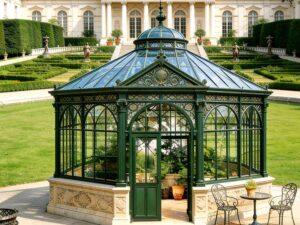
From the outset, we knew that the Victorian style offered the perfect architectural language for Jessica’s project. The Victorian greenhouse tradition—particularly the English and American interpretations of the 19th century—emphasized bold silhouettes, ornate detailing, and a celebration of glass and iron. It was a style born of an era when greenhouses were not merely utilitarian structures but expressions of wealth, curiosity, and a fascination with nature.

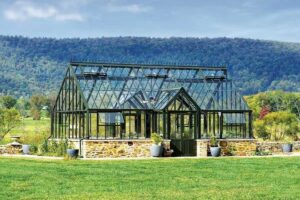
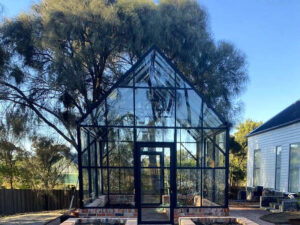
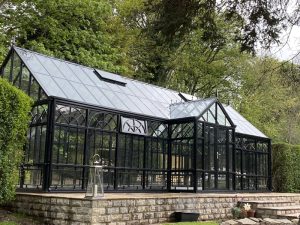
We proposed a fully custom, all-metal frame structure in a classic Victorian configuration. The framework would be the defining feature: clean, geometric, and deliberately bold. Rather than trying to hide the structure behind delicate profiles, we leaned into the visual language of wrought iron, using a robust metal frame that would read clearly against the glass. The geometry itself became ornamentation—diamond grid patterns on the gable ends, crisp sightlines along the walls, and a rhythmic repetition of vertical and horizontal members that gave the building a sense of order and permanence.

Jessica’s initial reaction to the renderings was telling. She said the building looked like it had always been meant to sit in that spot, tucked at the edge of her perennial borders where it would catch the morning sun and hold it through the afternoon. That sense of inevitability—of rightness—was exactly what we were aiming for.


The Anatomy of a Victorian Greenhouse

What made this structure truly special was not just its silhouette but the careful integration of form and function at every level.

The footprint settled at eighty square meters—generous enough to accommodate both dedicated growing areas and a seating space where Jessica could sit with her morning coffee surrounded by greenery, yet intimate enough to feel like a room rather than a conservatory. The building was anchored to a raised concrete base, a decision driven by both structural necessity and design sensibility. The concrete foundation provided a solid, level platform that would resist any ground movement during Virginia’s freeze-thaw cycles, while also creating a subtle visual separation between the greenhouse and the surrounding landscape. It gave the structure a sense of weight and rootedness, as though it had grown out of the earth rather than been set upon it.

The framework itself was executed in heavy-gauge aluminum, finished in matte black. There is a common misconception that historic greenhouses were always made of iron or steel, and while that was certainly true in the Victorian era, modern materials offer distinct advantages that align perfectly with the demands of a contemporary build. Aluminum gave us the slender profiles we needed to maximize glass surface area without compromising on structural integrity. It would never rust, never require repainting, and could be engineered to meet the wind and snow load requirements of Virginia’s varied climate—where summers can bring thunderstorms and winters occasional snowfalls. The black finish was chosen deliberately: it reads as traditional, almost like old wrought iron from a distance, while offering superior longevity and thermal performance up close.

The glazing system was designed to be as transparent as possible. We used double-paned, low-emissivity glass throughout, which not only provided exceptional insulation but also reduced glare and UV transmission that could damage sensitive plants or fade furnishings. The large expanses of glass were divided into smaller panes by the black metal muntins, preserving the historic aesthetic while allowing for modern thermal efficiency.


A Roof That Does More Than Shelter

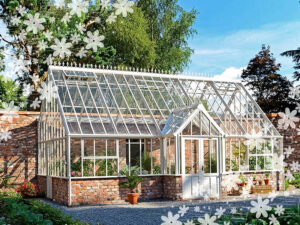
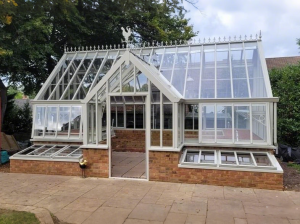
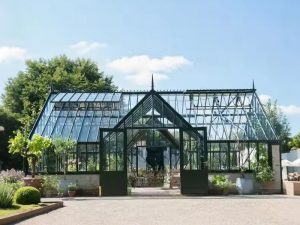
Perhaps the most distinctive feature of Jessica’s greenhouse is the roof. It is a true pitched roof, steep enough to shed rainwater efficiently and dramatic enough to give the building its Victorian character. At the front, a central gable extends slightly forward, creating a subtle entry portal that frames the double doors. The peak of this gable is crowned with a decorative finial—a small but significant detail that signals the level of craftsmanship invested in the project.

But the roof is not merely decorative. Along the ridge line, we installed a series of operable skylights, each one manually controlled to allow for fine-tuned ventilation. When combined with the louvered side windows, these ridge vents create a passive airflow system that keeps the interior comfortable even during Virginia’s humid summer afternoons. Hot air rises naturally to the peak and escapes through the open skylights, while cooler air is drawn in through the lower vents. It is a system that requires no electricity, no fans, and no complex controls—just an understanding of how air moves and a design that works with it rather than against it.

The double doors at the front deserve special mention. They are not just an entry point but a design feature in their own right. Flanked by tall side windows, the doors create a symmetrical facade that feels welcoming and formal at the same time. When both doors are swung open, the greenhouse effectively extends into the garden, blurring the line between indoors and out—a feature Jessica has since told us she uses constantly during the milder months of spring and autumn, which in Virginia can stretch from March well into November.


Building Through Challenges

Every custom project comes with its share of unexpected obstacles, and Jessica’s greenhouse was no exception. The site itself presented the first challenge. The chosen location was at the edge of her garden, a spot that received ideal sunlight but sat atop ground with variable soil composition. Virginia’s Piedmont region is known for its clay-heavy soils, which shift with moisture levels, and ensuring a stable foundation meant going deeper than originally planned with the concrete footings. This added time to the early stages of construction but was essential for preventing any future settling or shifting that could compromise the glass or frame.

Logistics were another consideration. The property was accessed via a winding driveway lined with mature trees that Jessica was determined to preserve. Our installation team worked with a smaller crane than usual, staging materials at a designated drop zone and hand-carrying components into position. It was slow work, but it preserved the character of her landscape and kept disruption to a minimum.

Weather, too, played its part. A stretch of unseasonably heavy rain during the foundation phase delayed the start of frame assembly by nearly two weeks, pushing the timeline further than we had hoped. Throughout this period, we maintained open communication with Jessica, updating her weekly on progress and adjusting schedules as conditions changed. She later told us that transparency during that phase mattered as much to her as the quality of the final build—a reminder that construction is as much about trust as it is about materials.


The Final Reveal

When the last pane of glass was set and the final sealant cured, we walked through the greenhouse with Jessica on a late spring afternoon. The sun was low enough to cast long shadows through the diamond grids of the gable, and the interior was flooded with a soft, golden light that seemed to warm the space even before any heating system was turned on.

The concrete base, now finished with a subtle gray wash, anchored the structure against the emerging green of the garden. The black frame stood in sharp contrast to the glass, each muntin casting its own shadow across the interior floor. From the outside, the greenhouse presented a facade of symmetry and restraint—the pitched roof, the central gable, the finial catching the light, the double doors waiting to be opened.

Inside, Jessica stood in the center of the space, looking up at the ridge vents and the sky beyond. She pointed to the corner where she planned to place a mature lemon tree, and to the opposite side where a small seating area would go. It was clear that in her mind, the structure had already become what she had hoped for: not just a greenhouse, but a room with purpose.

Her feedback, when it came, was direct and heartfelt. She said the greenhouse exceeded her expectations in ways she hadn’t anticipated—particularly the way the black frame seemed to disappear against the glass during the day, letting the garden take center stage, while at night it held the light within like a lantern. She noted how the ventilation system worked so effectively that she hadn’t yet needed to install the backup cooling system she had budgeted for. And she remarked, with satisfaction, that several neighbors had already asked who built it.


Project Summary

  • Project Type: Custom Victorian-style glasshouse (greenhouse / sunroom)

  • Location: Virginia, United States

  • Total Area: 80 square meters

  • Frame Material: Heavy-gauge aluminum, matte black powder-coated finish

  • Glazing: Double-paned, low-emissivity tempered glass

  • Foundation: Reinforced concrete base with frost footings

  • Roof: Pitched design with operable ridge vents and decorative finial

  • Entry: Symmetrical double doors with flanking side windows

  • Design Features: Diamond grid gable detailing, full-metal frame, passive ventilation system

  • Construction Timeline: 14 weeks (including site preparation, foundation work, frame assembly, glazing, and finishing)


A Lasting Addition

Jessica’s greenhouse is now in its second year of use, and it has become exactly what she envisioned—a space that supports her passion for horticulture while offering a quiet place to read, to entertain, or simply to sit surrounded by growing things. She has expanded her plant collection to include varieties she never could have grown before, and she spends time in the greenhouse throughout the winter, when the garden outside is dormant and the glasshouse becomes a pocket of green and warmth.

For us, this project represents the kind of work we are most proud of. It is not just a structure built to specifications, but a collaboration that resulted in something that feels personal, authentic, and enduring. The Victorian style, with its emphasis on craftsmanship and proportion, gave us a rich language to work with. The metal frame gave us the strength to realize it. And Jessica’s vision gave us the direction.

In the end, a greenhouse is more than the sum of its materials. It is a framework for a particular way of living—one that values light, growth, and the quiet pleasure of being surrounded by nature, no matter the season. We are honored to have built that framework for Jessica, and we look forward to seeing how her garden, and her life within it, continues to grow.

Case Study: A Victorian Greenhouse in Virginia

Want to customize a greenhouse?

If you also wish to have a custom-made sunroom that is uniquely yours, please "Contact Us"

Request Free Quote Now

FAQ

We have our own factory and the trading company is just for exporting.

Yes, we can provide material samples free of charge, but we don't bear the freight.

Please let us know the size of greenhouses are needed?And tell us the usage of the greenhouse.Is it for leisure, family gatherings, or as a studio? So that we can suggest related models.

Please let us know where the greenhouse is (temperature, wind speed)

We have professional after-sales service engineers who will provide planning drawings and installation manuals.

Let's Discuss Your Vision

Have questions about Greenhouse solutions? Leave a message below.

Your information will be kept confidential.

Greenhouse Factory whatsApp
logo