Menu


Low-E Coating: Which Side Faces Out? (Sunroom Guide)
Confused about Low-E glass direction? Avoid a 90% common mistake. Discover the scientific rule for sunroom comfort & energy savings.
If you are building or using a sunroom, you have probably heard about Low-E glass. It is the magic layer that keeps the room cool in summer and warm in winter. But here is a secret that often gets ignored.
Which way should the coating face? Should it go inside or outside?
I asked this question to ten different sunroom owners last week. Nine of them gave the wrong answer. Do not worry, you are not alone. This is a very common point of confusion. Even some installers get it wrong.
In this guide, I will explain the logic behind the glass. We will look at the science and the data. By the end, you will know exactly how to check your windows. You will also know how to make your sunroom as efficient as possible.
Let’s clear this up once and for all.
The Simple Answer: It Depends on Your Climate
The truth is not as simple as “always inside” or “always outside.” The correct placement of the Low-E coating direction relies on where you live. It also depends on what you need from your sunroom.
Do you want to trap heat inside during a cold winter?
Or do you want to blast away solar heat during a hot summer?
These two goals require opposite setups. A study on energy balance confirms that window orientation and climate change how the coating should be applied -1. The goal is to manage the Solar Heat Gain Coefficient (SHGC). This is just a fancy term for how much sun heat passes through the glass.
Understanding the “Numbered” Surfaces
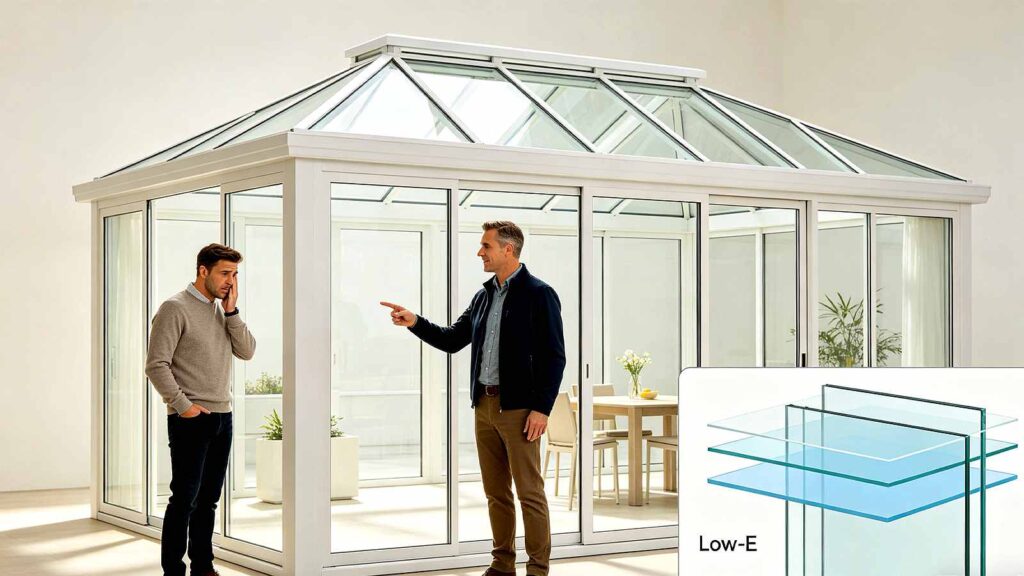
To talk about this clearly, imagine your sunroom glass. It is usually double-paned. We count the surfaces from the outside in.
Surface #1 is the outdoor side of the outer glass.
Surface #2 is the indoor side of the outer glass (this is the gap).
Surface #3 is the outdoor side of the inner glass (facing the gap).
Surface #4 is the indoor side of the inner glass.
Your Low-E coating can live on Surface #2 or Surface #3. The difference between these two spots changes everything -2.
Scenario A: The Cold Climate Rule (Keeping Heat In)
Imagine you live in a place with snowy winters. Your sunroom acts like a warm blanket. You want to keep the expensive heat inside.
What should you do?
The coating should face the inside of the room (Surface #3).
Why?
In winter, your heater warms up the room. That heat tries to escape outside through the glass. The Low-E coating acts like a mirror for heat energy. It bounces the room’s heat back into the sunroom.
But wait, there is a bonus.
You still want the sun’s warmth to enter for free. By placing the coating on Surface #3, you let the short-wave sun energy in. It hits the floor and turns into heat. That heat cannot escape back out because the coating blocks it. This is called passive solar heating. Research indicates that using Low-E glass in this way can reduce energy consumption significantly, with some studies showing up to 80% less energy used compared to standard glass -3.
Scenario B: The Hot Climate Rule (Keeping Heat Out)
Imagine you live in a sunny, hot place. Summer lasts for months. You want your sunroom to feel like a cool oasis.
What should you do?
The coating should face the outside (Surface #2).
Why?
You want to stop the heat before it enters your room. The sun beats down on your sunroom. The coating on Surface #2 reflects that solar radiation away. It bounces it back to the outdoors.
This keeps your chairs, floors, and air much cooler. You will not have to run the air conditioner as hard. In hot climates, blocking solar heat is the priority. This specific placement reduces the “greenhouse effect” in your sunroom. It stops the space from turning into an oven.
The Data Table: Which Side is Right for You?
To make this very clear, here is how to decide. This is based on standard building physics for residential sunrooms.
Your Climate Zone
Cold North
Placement of Coating
Surface #3 (Inner glass, facing room)
The Main Goal
Trap interior heat (Low U-Factor)
Your Climate Zone
Hot South
Placement of Coating
Surface #2 (Outer glass, facing gap)
The Main Goal
Block solar entry (Low SHGC)
Your Climate Zone
Mixed (Both seasons)
Placement of Coating
Surface #2 (Prioritize summer)
The Main Goal
Balance, but lean towards heat rejection
Why 90% of People Get It Wrong
Most people assume the coating goes “inside the house.” They think, “I want to protect the coating from weather.” Or, “It should be near the room.”
But air conditioning changes the math.
If you put a heat-reflecting coating on the inside in a hot climate, you trap the heat inside the room. That is the worst mistake you can make. You would actually make the room hotter.
It is counter-intuitive. The correct Low-E coating direction for hot areas is actually facing the outdoor side (hidden in the air gap). It feels “outside,” but it is the only way to reflect the sun’s power before it loads up your AC unit -4.
What About the “Fog” Test?
You can check your existing sunroom. Hold a lighter or a flashlight near the glass at night. Look at the reflection of the flame.
If you see three flames? You have standard glass.
If you see four flames? That means the Low-E coating is present.
But does it tell you the side? Not really. You need a specialized tool to see the exact surface. However, if you feel a lot of heat radiating from the glass on a sunny day, the coating might be on the wrong side for your climate.
Does the coating wear out?
Modern Low-E coatings are incredibly durable. They are applied to the inside of sealed glass units. You cannot scratch them off with a sponge. They are protected from air and moisture. However, the position matters for performance, not longevity. A 2024 study on optical properties confirmed that shifting the membrane position changes the遮阳 coefficient significantly, proving that orientation is key for function -5.
The “Cheat Sheet” for Your Contractor
When you order your sunroom, do not just say “I want Low-E glass.” You must be specific.
If you live in Texas or Florida, say this:
*“I need a Low-E coating on surface #2 for solar control. I need a low SHGC.”*
If you live in Minnesota or Maine, say this:
*“I need a Low-E coating on surface #3 for passive heating. I want a high SHGC for winter.”*
Do not let them guess. You now know the rule. The industry standard for hot climates is to put the film on the second surface -7. This is your house. You are paying for performance.
Does the thickness of the glass change the rule?
No. The Low-E coating direction rule stays the same regardless of thickness. Whether it is 3mm or 5mm glass, the physics of radiation does not change. The coating does the work, not the thickness. The glass is just the holder for the coating.
A Note on “Hard Coat” vs. “Soft Coat”
You might hear these terms. “Hard coat” is applied during manufacturing. It is tougher. “Soft coat” is applied in a vacuum. It is more efficient but must be sealed inside the unit. Soft coat is usually better for energy savings. However, both types follow the direction rule based on your climate needs.
What about triple glazing?
If your sunroom has three panes of glass, you have more surfaces. But the principle remains the same.
Cold climate: Keep the coating closer to the inside room.
Hot climate: Keep the coating on the outside half of the unit.
My Final Recommendation
I believe most sunroom owners should prioritize heat rejection. Why? A sunroom is a glass box. The sun is powerful. Overheating happens faster than underheating.
Unless you live in the far north, choose Surface #2. It is the safest bet. It protects you from the intense midday sun. If you are cold in the winter, you can add a space heater. But if you are hot in the summer, you cannot escape it easily.
Summary
Do not be part of the 90% statistic. Look at your climate.
Cold weather? Keep the heat in (Surface #3).
Hot weather? Push the heat out (Surface #2).
You now have the knowledge to make your sunroom a comfortable paradise all year round. Go check your windows. If you see a hazy reflection or feel heat on a cloudy day, maybe your installer put it in the wrong spot. Now you know how to fix it.
References / Supporting Data
-
Energy balance analysis of Low-E insulating glass windows. (2004). Glass & Enamel.
-
Low-E Glass Installation Standards. (2023). Building Construction Materials Database.
-
Dynamic Simulation of Energy Consumption in Passive Solar Houses. (2011). Journal of Anhui Agricultural Sciences.
-
Vacuum Glass Positioning and Low-E Film Impact. (2022). Glass Industry News.
-
Influence of Film Position on Optical Indexes of Low-E Glass. (2024). Fujian Building Materials.
-
Coated Glass Selection Guide. e-China Silicate Society.
-
Low-E Film Position for Sunrooms. (2024). Industry Calculation Models.
Related_products







Why Choose Us?
1
As the first manufacturer in China to introduce the Victorian conservatory design from Europe, we have 36 years of production experience since 1988, and our products are distributed in 68 countries.
2
We have a professional team of 8 conservatory design engineers and 60 production workers. We are equipped with 2 hot-dip galvanizing machines, 2 steel shot blasting machines, and 1 spray line.
3
Our professional design team can provide theoretical calculation data support for wind pressure resistance, earthquake resistance, and snow resistance of large-scale steel structure conservatories.
4
Strict quality control. 8 inspection stages: raw material inspection, cutting and blanking size inspection, welding quality inspection, hot-dip galvanizing quality inspection, spray quality inspection, assembly quality inspection, and packaging quality inspection. Ensuring smooth assembly of the products, no rust, no leakage, and compliance with customer national standards.
5
We cooperate with many well-known architectural design companies worldwide.
6
Customized services. We can customize according to customer designs and dimensions. We also provide supporting facilities such as electric sunshades and air conditioners.
7
We offer installation dispatch services, inspection services, and free replacement of parts. We also present high-value exquisite gifts.
8
Video factory tour. You can view the entire production process.
Ready to Bring Your Greenhouse to Life?
Have questions about Greenhouse solutions? Leave a message below.
Your information will be kept confidential.
Call us: +86 138 3370 5565 • Email: admin@hengshengcasting.com