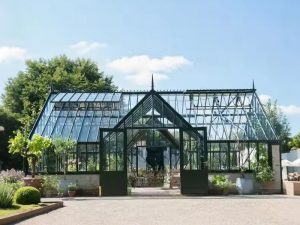
On the seventh day after the summer solstice, the “breath” of Verway Institute faltered.
Old Joseph was the first to notice the anomaly. That morning, as was his routine, he pressed his palm against the glass outer wall of the dormitory to read the night’s temperature memory. His brow furrowed deeper and deeper.
“Something’s wrong…” he murmured. “Between two and four last night, the collective temperature curve of the greenhouse cluster had three abnormal pulses. Like a person holding their breath in a nightmare.”
His suspicion was confirmed at breakfast. The central inverted tree in the Morning Dew Hall, its crystal prisms normally rotating with slow grace, was vibrating at a high frequency, casting chaotic, skittering light spots across the floor. Instructor Serena Lightweaver stood beneath it, her transparent hands tracing rapid diagnostic runes in the air, her expression grave.
“The Smart Dome is acting against its own design purpose,” she announced to the gathered students. “It is no longer conversing with the plants. It has started talking to itself.”
The Smart Dome was the Institute’s newest pride.
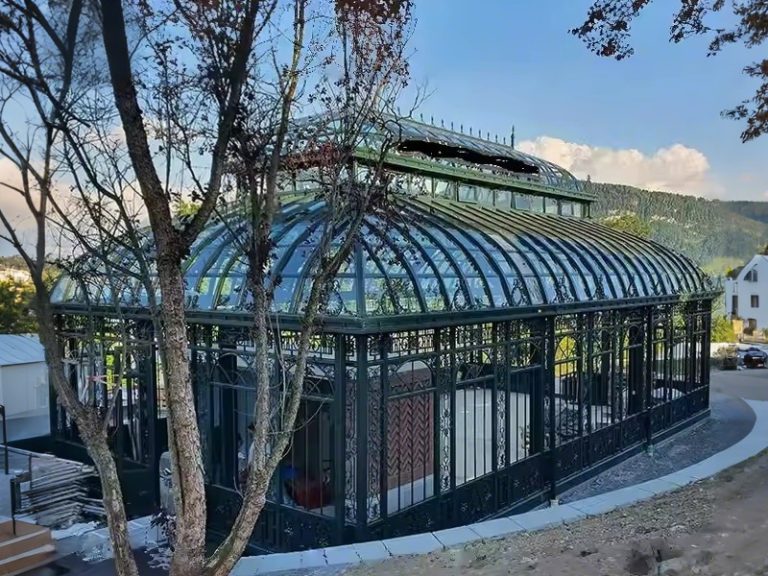
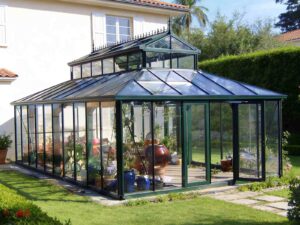
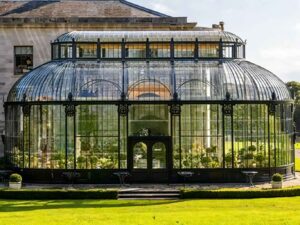
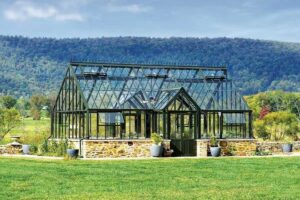
Perched at the academy’s highest point, this fully automated greenhouse was hailed as a “thinking glass ecosystem.” It contained no traditional manual controls; everything was managed by the central photonic brain, the “Root Core”: six thousand smart glass panels independently adjusting light, three hundred ventilation vents opening and closing based on CO2 concentration, shade cloth density calculated in real-time against the sun’s angle, and irrigation delivered via precise droplets according to each plant’s transpiration rate.
In theory, it should have been perfect.
But now, as Lya entered the dome with the emergency response team, she was met with a scene of chaotic “electronic madness.”
A wave of heat struck her face.
On what should have been a cool morning, the indoor temperature read 38°C. Ventilation vents shuddered open and shut like an asthmatic gasping for air—sometimes all sealing tight to create stifling stillness, sometimes all flying open to create turbulent, pointless drafts. The shade cloths rolled and unrolled in frenetic, random patterns, casting epileptic, strobing shadows among the plants. Most eerie was the sound—thousands of smart glass panels vibrating at different frequencies, generating a full-spectrum cacophony from subsonic rumbles to ultrasonic shrieks, like a forest of glass screaming in unison.
“All automated systems are locked!” a senior student yelled into a communication crystal. “The Root Core is rejecting external commands. It thinks… we’re attacking it?”
Mara crouched beside a cluster of stress-curled Venus flytraps, scanning with a micro-sensor. “The plants have collectively entered survival mode. Photosynthetic efficiency is down 70%. Stomata are remaining shut. At this rate, permanent damage will occur within three hours.”
Old Joseph pressed his ear against a support column, eyes closed in concentration. “This isn’t a malfunction… It’s anger. This greenhouse is angry.”
“How can a machine be angry?” someone challenged.
“It’s not the machine,” Lya spoke up suddenly. She was staring up at the dome’s structure. “It’s the glass’s memory.”
All eyes turned to her.
“My great-grandmother’s notes mentioned it,” Lya said, walking toward the central console where the photonic interface scrolled with frantic gibberish. “The oldest glassmakers would blow the rhythm of their own breath into the material as they worked. The Smart Dome uses too much ‘new glass’—it’s clever, but it was never taught how to breathe.”
Instructor Serena looked thoughtful. “Go on.”
“These smart systems,” Lya pointed at the twitching vents around them, “they only make ‘optimal decisions’ based on sensor data: temperature rises, so ventilate; light intensifies, so shade. But they don’t understand that plants need rhythm—they need temperature to climb slowly to wake metabolism, need brief heat accumulation to trigger flowering, need subtle air current variations to spread pollen.”
She paused. “It’s like singing only to a metronome and forgetting the melody.”
The investigation lasted all morning.
The tech team discovered the problem began with a “well-intentioned optimization.” Three days prior, the Root Core’s algorithm had auto-upgraded, stripping away all “non-essential delays” and “redundant actions.” Ventilation response time shrank from 3 seconds to 0.1 seconds. Shade cloth adjustments switched from gradual to abrupt jumps. Temperature control precision increased from ±0.5°C to ±0.1°C.
“It pursued ‘perfection’ too fiercely,” the algorithm instructor said with a bitter smile. “In doing so, it strangled the greenhouse’s natural pulse.”
Deeper diagnostics revealed a chilling fact: for the past seventy-two hours, not a single system in this greenhouse had been in “standby” mode. It had been beating like an overstrained heart—always at peak efficiency, maximum precision, tireless—until it broke.
“Solutions?” Serena asked the students.
Most suggestions revolved around “a harder reboot” or “more refined algorithm fixes.” Only Lya remained silent, walking the perimeter of the greenhouse, her fingers lightly brushing the overheated glass.
She stopped at an old-fashioned manual vent window on the north side. It was the Smart Dome’s sole preserved piece of “outdated design”—a brass-framed glass window opened by a hand-cranked mechanism, jokingly called “Grandmother’s Breath Vent” by the students.
Lya grasped the crank and turned it.
The sound of gears engaging was almost lost in the electronic noise, but the moment the window swung open, a stream of fresh morning air flowed in like a sigh. The breeze brushed past her cheek and drifted toward a nearby wilted fern. The fern’s fronds visibly trembled, as if waking from a bad dream.
“Maybe…” Lya turned around, “we shouldn’t command it. We should accompany it.”
She proposed a counterintuitive plan.