Walking along the mushroom-lined path, Lia felt like a seed that had just landed, its roots still testing the unfamiliar soil.
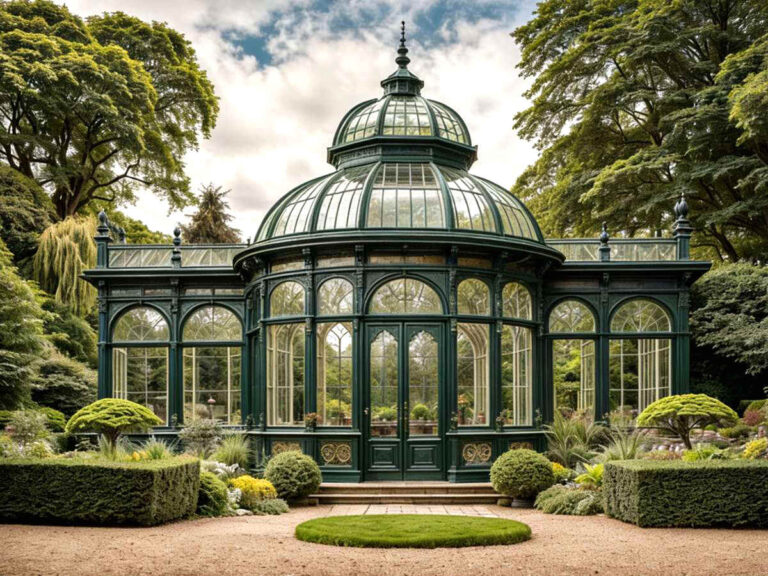
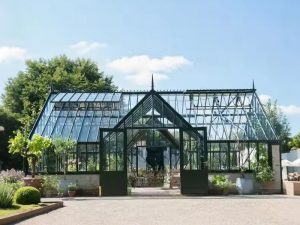
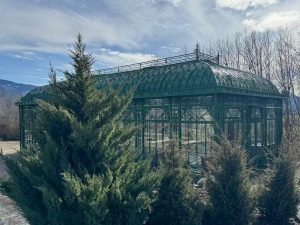
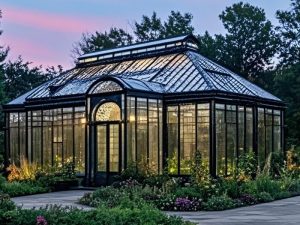
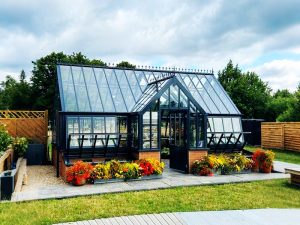
After a short distance, a grand glass hall resembling a crystal palace came into view.
The air inside the glass palace had weight—not oppressive, but like being immersed in a perfectly concentrated nutrient solution. Each breath filled her lungs with a clean, vibrant energy. The “ground” beneath her feet was startlingly transparent, revealing a glowing root network sprawling like an underground galaxy dozens of meters below. Even deeper, she could see the pulse of flowing water, as if the building had its own circulatory system.
“This is the Reception Corridor of the Root Hall,” Erol’s voice drew her attention back. “Before the sorting ceremony, you must understand why you are here.”
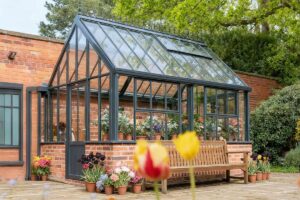
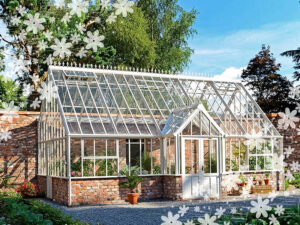
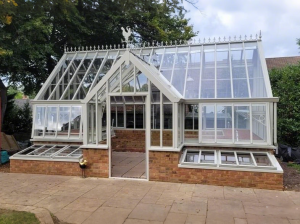
They stopped before a massive glass wall. Encased within was a miniature greenhouse model—an exact replica of Lia’s family greenhouse, down to every detail, even the cracks in the glass.
“The greenhouses in your world,” Erol gently touched the glass surface, and golden light paths illuminated the model, “some are ‘anchors’ we intentionally left behind. Over the past centuries, the academy’s master glassmakers traveled as wanderers, architects, or even mysterious eccentrics, designing greenhouses for families with ‘a special sensitivity to plants.’”
The model on the wall began to transform, displaying over a dozen different greenhouses: a glass dome on Nordic tundra, a crystal obelisk in a desert oasis, a floating glass box atop a Tokyo skyscraper… Each contained the same hidden geometric language.
“These designs are not arbitrary,” Erol traced complex light patterns in the air. “They follow ‘Light Geometry’—an architectural code calculated from local latitude, celestial trajectories, even Earth’s magnetic fields. When specific celestial moments arrive, like the night the apple blossoms first open in your hometown under a full moon…”
The miniature greenhouse suddenly emitted a silver-white beam.
“…the anchor activates, becoming a temporary passage.” Erol looked at Lia. “Your great-grandmother, Esmeralda Green, was one of the academy’s most gifted spectral readers in three hundred years. She chose to return to your world, marry, garden, and grow old—but left this invitation in the backyard, waiting for the next person in the family who could ‘listen.’”
Lia felt a tightness in her chest. Fragmented memories of her great-grandmother took on new meaning: the old woman polishing glass under moonlight, pointing at stars and saying, “They’re arranging codes”; her insistence on a specific slanted roof angle, “otherwise the light won’t travel right.”
“She was waiting for me?” Lia’s voice trembled.
“No,” Erol corrected gently. “She was waiting for ‘possibility.’ And you turned possibility into reality.”
Deep in the hall, the bell chimed again—this time seven notes, each tone corresponding to a color of the spectrum.
“It’s time.”
The Root Hall was more… organic than Lia had imagined.
It had no clear walls, only layers of transparent partitions woven by living vines across glass frames. Hundreds of new students gathered in the center, their robes already displaying different botanical traits: tiny succulents sprouting from sleeves, miniature orchids blooming on collars, fern leaves peeking from a boy’s hair.
At the center of the hall floated a crystal twice a person’s height. Unlike ordinary crystals, it seemed to encapsulate a shattered rainbow—countless colors swirling, separating, and reforming within.
“The Spectral Crystal,” Erol explained softly. “It doesn’t test your ability but reads your ‘frequency preference’ for resonating with plants. Now, step forward in name order.”
The first was a nervous city girl. As her hand touched the crystal, the light inside surged toward the blue spectrum, projecting neat grid patterns on the floor—like a city garden layout.
“Urban Agri-Hall!” a resonant voice announced.
Next was a boy with sun-darkened skin. At his touch, the crystal blazed with orange-red light, casting terraced field shadows.
“Mountain Cultivation Hall!”
Lia waited in line, feeling the apple seed in her palm warm slightly. She observed everyone’s light patterns: precise hexagonal honeycombs (Pollination & Insect Synergy Hall), wavy curves (Aquatic Botany Hall), intricate neural-like branches (Medicinal Plants Hall)…
“Lia Green.”
She stepped forward. The crystal’s surface was cool, but a gentle pulse throbbed within. She pressed her right hand against it—
Sudden silence.
All colors inside the crystal stilled, then began swirling counterclockwise. Instead of separating, they merged into an indescribable base hue between gold and tender green. This light poured from the crystal’s core, spilling onto the floor.
The shadow on the floor began to grow.
Starting from a single point, it spiraled outward, each new arc following precise mathematical ratios: 1, 1, 2, 3, 5, 8, 13… The rotating arcs formed a perfect spiral—like the heart of a giant sunflower, the scales of a pinecone, or the sacred geometry of a hurricane seen from above.
“A Fibonacci spiral…” someone in the crowd gasped.
“Primordial Dome Hall!” The announcement was louder than any before, tinged with rare excitement.
Mentor Erol stepped to her side, his eyes gleaming with confirmation. “The oldest hall, focused on the fundamental rhythms of all growth. Welcome home, Lia.”
The Primordial Dome Hall dormitory was housed in a massive glass hemisphere. Here, light was specially treated to mimic Earth’s early atmosphere—soft, even, as if time itself had texture.
Lia’s room was on the third floor, accessible by a spiral staircase woven from living bamboo. The door was a pane of smart glass that turned transparent at her palm print, revealing the interior.
The room was circular, with walls of adjustable transparency, currently semi-translucent, hinting at the layered botanical platforms outside. It was naturally divided into three wedge-shaped sections, and her two roommates had already “cultivated” vastly different micro-worlds in their corners.
“Ah, the last one’s here!” a cheerful voice called from near the entrance.
A petite girl rose from a cluster of miniature landscapes. On her worktable, dozens of glass jars held complete micro-ecosystems: mossy forests, desert succulent canyons, even a circulating mini-swamp. Her sleeves were rolled up, hands dusted with sphagnum, her smile like wildflowers stubbornly blooming in city balcony cracks.
“I’m Mara, from Singapore,” she spoke quickly, her gestures even faster. “Balcony gardener, or… micro-universe sculptor. Your corner is great—east-facing morning light is perfect for photoperiod-sensitive plants. Want me to design a starter ecosphere for you?”
Before Lia could answer, a slow, raspy voice came from the depths of the room: “Let her breathe, little whirlwind.”
The innermost corner resembled a condensed temperate forest. An elderly man with white hair sat on a root-shaped seat, a thick cross-section of pinewood on his lap. His fingers gently traced the growth rings, eyes closed as if listening.
“Old Joseph,” he opened eyes the deep brown of tree bark. “Watched trees in Oregon for sixty years. Your spiral was beautiful, child—I’ve seen almost identical growth patterns on Northwest coast redwoods.”
He raised the wood slice. “This Douglas fir died in last year’s wildfire. But it remembers the warmth of a hundred and twenty-seven springs, which years of drought tightened its rings, which year deer rubbed antlers on its bark… A tree’s memory is far more honest than a human’s.”
Mara bounced over, handing Lia a steaming mug: “Try this—my own ‘Adaptation Tea.’ Chamomile to calm, mint to refresh, plus a bit of local glowing mycena powder to help your body clock adjust to academy time.”
The tea tasted of soil and starlight.
Lia cradled the cup, settling into her corner. Her space was still empty, just the academy-provided basic planting table and a blank smart glass wall. On impulse, she focused, and the glass wall turned transparent, revealing the view “outside”—if it could still be called a window
:
The Primordial Dome Hall’s massive greenhouse unfolded in layers below. The top level simulated alpine meadows, the middle held temperate mixed forests, the lower section was a tropical cloud zone, and at the very bottom glowed a small cave of luminescent fungi. Students and mentors moved across transparent walkways; some rode giant beetles through foliage, others sketched irrigation routes in the air with light-pens.
“Rules are simple,” Old Joseph drawled. “At six each morning, the glass wall shows the day’s schedule. Weekly ‘growth journal’ submissions—not homework, proof of dialogue between you and your plants. Monthly inter-hall competitions… Oh, and never keep carnivorous plants by your pillow on a full moon, unless you want digestion dreams.”
Mara giggled: “He’s talking from experience! But seriously,” she turned to Lia, earnest, “the spiral in your palm… that’s a primordial pattern. In my homeland’s tales, only those who hear the land’s heartbeat awaken such a spiral.”
Lia looked at her palm. In the academy’s light, her palm lines seemed to faintly glow, forming a shallow vortex pattern.
She walked to the blank glass wall and pressed her left hand—still holding the apple seed—against it.
The wall sensed her touch, displaying a menu:
【Adjust Light Cycle】【Set Humidity Gradient】【Connect Root Monitoring Network】【Request Soil Analysis】【Summon Mentor Consultation】…
At the very bottom, the simplest option: 【Begin Planting】.
Lia tapped it.
The wall transformed into virtual soil, deep brown and waiting. After a moment’s hesitation, she gently pressed the now-semi-transparent apple seed into the “soil” center.
Instantly, the wall illuminated with simulated root growth—not real roots, but a visualization of the seed’s potential. Roots explored downward, branched, connecting to the academy’s underground network; in the stem’s light above, branches forked, each tip displaying different possibilities: flowering time, fruit flavor profiles, disease resistance tendencies…
“It’s asking what kind of apple tree it wants to be,” Old Joseph appeared behind her, voice low. “Not what you want it to be, but what it itself wants. That’s our hall’s first lesson: listen, don’t command.”
Lia closed her eyes.
She imagined her great-grandmother’s hand stroking bark, her father’s laughter during harvest, the sweet-tart taste of the first apple she’d picked under the tree at age five. She stopped thinking, “What should I grow?” and let those memories, scents, textures flow through her, passing through her palm to the seed’s light within the wall.
When she opened her eyes, the projection had changed.
The roots chose the deepest exploration path; branches favored spread over compactness; the simulated flowers were a pale gold she’d never seen; the predicted flavor curve of the fruit was as complex as a symphony—initial sweetness, mid-notes of subtle tartness, a honeyed aftertaste.
Words appeared on the wall:
“Planting preferences confirmed: Wildness 70%, Yield 85%, Flavor Uniqueness 92%. Matching with true seed bank…”
Outside, the Primordial Dome Hall’s lights lit up layer by layer, like an inverted starfield. Distant, muffled singing drifted in—perhaps some hall’s evening ritual.
Mara was already adding glowing krill to her micro-ecosphere; Old Joseph resumed tracing his growth rings. From the ceiling above Lia’s glass wall, a real crystal cultivation pod descended, containing three different apple seeds, each annotated with lineage and history.
She lifted her hand from the wall. The spiral pattern in her palm slowly faded, but a warm sense of connection remained.
In that moment, she understood: sorting wasn’t assignment, but confirmation.
The Spectral Crystal had merely reflected the shape she already carried within.